About Natural Climate Solutions
IN THIS MODULE
You will learn about:
What are natural climate solutions?
Principles of natural climate solutions
The carbon cycle
Three kinds of natural climate solutions
Natural climate solutions in a changing climate
KEY TERMS
What are natural climate solutions?
A natural ecosystem is a place where plants, animals, and other life forms interact with each other and their native environment. It includes forests that have never been logged, wetlands that have never been drained, and grasslands that have never been plowed or planted.
Natural climate solutions are deliberate human activities that work with nature to address the global climate and biodiversity crises simultaneously. Natural climate solutions are actions that do not move ecosystems further away from their natural state. [1] An ecosystem’s ability to store and sequester carbon is tightly linked to its biological diversity. [2] Natural ecosystems are more effective than degraded ones at storing carbon.
About one-third of the greenhouse gas emissions reductions needed in the next decade could be achieved by improving nature’s ability to absorb emissions. [3] Conserving and restoring natural spaces, both on land and in the water, is essential for limiting carbon emissions and adapting to an already changing climate. [4]
NCS can be categorized into three groups:
Protecting natural ecosystems;
Restoring degraded ecosystems;
Improving management in working landscapes.
-
[1] Ellis, P.W., Page, A.M., Wood, S., Fargione, J., Masuda, Y.J., Carrasco Denney, V., Moore, C., Kroeger, T., Griscom, B., Sanderman, J. and Atleo, T., (2024). The principles of natural climate solutions. Nature Communications, 15(1), 547.
[2] Weiskopf, S.R., Isbell, F., Arce-Plata, M.I., Di Marco, M., Harfoot, M., Johnson, J., Lerman, S.B., Miller, B.W., Morelli, T.L., Mori, A.S. and Weng, E., (2024). Biodiversity loss reduces global terrestrial carbon storage. Nature communications, 15(1), 4354.
[3] Federici, S., Lee, D. and Herold, M., (2017). Forest mitigation: A permanent contribution to the paris agreement. WorNing Pap, 1-24.
Grassi, G., House, J., Dentener, F., Federici, S., Den Elzen, M. and Penman, J., (2017). The key role of forests in meeting climate targets requires science for credible mitigation. Nature Climate Change, 7(3), 220-226.
Griscom, B.W., Adams, J., Ellis, P.W., Houghton, R.A., Lomax, G., Miteva, D.A., Schlesinger, W.H., Shoch, D., Siikamäki, J.V., Smith, P. and Woodbury, P., (2017). Natural climate solutions. Proceedings of the National Academy of Sciences, 114(44), 11645-11650.
Roe, S., Streck, C., Obersteiner, M., Frank, S., Griscom, B., Drouet, L., Fricko, O., Gusti, M., Harris, N., Hasegawa, T. and Hausfather, Z., (2019). Contribution of the land sector to a 1.5 C world. Nature Climate Change, 9(11), 817-828.
[4] United Nations, (2025). Biodiversity: our strongest natural defence against climate change. Available from: https://www.un.org/en/climatechange/science/climate-issues/biodiversity
Principles of natural climate solutions
Ensuring the effectiveness and integrity of natural climate solutions (NCS) requires adherence to five foundational project design principles, which are listed below. [5]
Moreover, NCS projects should have the support of the Indigenous communities whose land the project is taking place on. The Restore, Assert, Defend Network (RAD Network) Tools and Resource Database has information on building relationships, Free Prior and Informed Consent, and decolonizing conservation and land planning. [6]
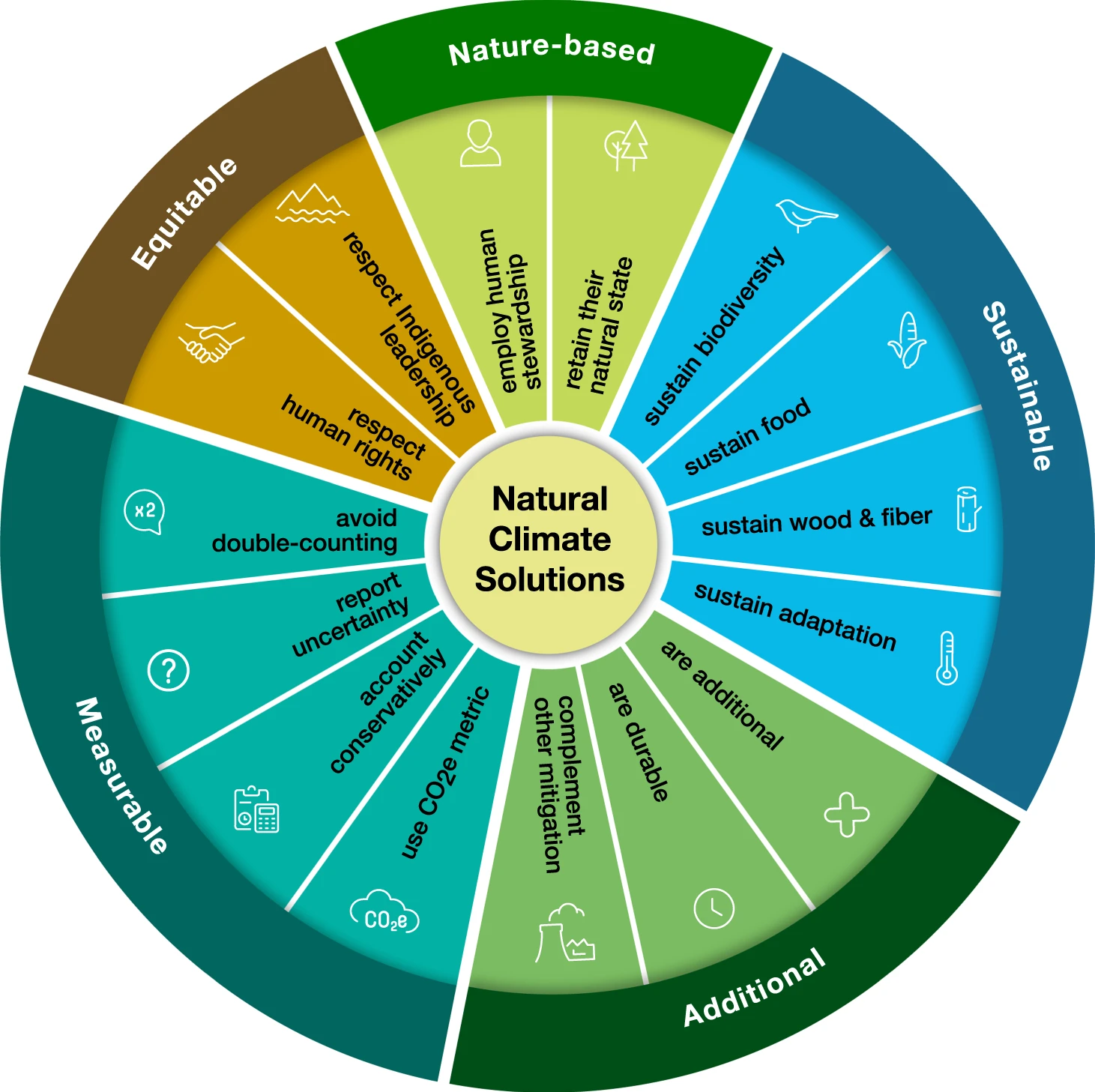
Graphic from Ellis et al. 2024
Principle 1: NCS are Nature-based.
NCS projects should ensure ecosystems remain in their natural condition.
Principle 2: NCS are Sustainable.
A high-quality NCS project results in durable, long-lasting climate benefits.
Principle 3: NCS are Climate-additional.
A natural climate solution creates new climate benefits that go beyond what is required by law, regulations, or business as usual.
Principle 4: NCS are Measurable.
NCS create tangible, real, and achievable emission reductions that can be quantified following scientifically sound methods to produce realistic and conservative results.
Principle 5: NCS are Equitable.
NCS need to carefully consider the potential impacts and implications for all rightsholders and stakeholders who may be affected by the project.
-
[5] Ellis, P.W., Page, A.M., Wood, S., Fargione, J., Masuda, Y.J., Carrasco Denney, V., Moore, C., Kroeger, T., Griscom, B., Sanderman, J. and Atleo, T., (2024). The principles of natural climate solutions. Nature Communications, 15(1), 547.
[6] RAD Network, (n.d.) “Additional Tools & Resources,” https://radnetwork.ca/additional-tools-resources/
IPCA Knowledge Basket, (n.d.) “Working Respectfully with Indigenous People and Their Knowledge Systems,” https://ipcaknowledgebasket.ca/resources/working-respectfully-with-indigenous-people-and-their-knowledge-systems/.
The Land Needs Guardians. Available from: https://landneedsguardians.ca/what-guardians-do
[7] Indigenous Leadership Initiative. Available from: https://www.ilinationhood.ca/guardians.
The carbon cycle
Indigenous Guardian programs
Throughout the implementation of the NCS, climate benefits need to be continuously monitored to account for the actual emission reduction that was created through implementing the project. Guardians are trained in both Indigenous and Western sciences, and can carry out needed protection, management, restoration, and monitoring activities while supporting cultural uses on the ground. [7]
Project monitoring can be fully led, or supported by, community members and Indigenous Guardian programs to create a long-term monitoring plan. The number of Guardian programs has grown from 30 in 2016 to over 200 in 2024. [8] Guardians can co-manage an NCS project while providing meaningful and well-paying employment to Indigenous community members.
Footnotes
[7] Indigenous Leadership Initiative. (n.d.). The land needs guardians. https://landneedsguardians.ca/what-guardians-do
[8] Indigenous Leadership Initiative. (n.d.) Indigenous Guardians. https://ilinationhood.ca/guardians
How atmospheric carbon is enhanced by industrial activity
Earth’s atmosphere is made up of greenhouse gases (GHGs) that keep Earth within a temperature range that supports life.
Carbon dioxide (or CO₂) is a gas that continually moves from the atmosphere to the Earth and then back to the atmosphere. It is released back into the atmosphere when plants and animals die, when fires burn, volcanoes erupt, and fossil fuels like coal, natural gas, and oil are burned.
The life cycles of plants and animals, grassland and forest fires and volcanic eruptions are “background” processes that have been taking place for many millennia, while the extraction and burning of fossil fuels are activities carried out only by modern humans.
The burning of fossil fuels and the conversion of natural ecosystems like forests, grasslands, and wetlands for roads, farming, logging, and urban development, as well as industrial development and resource extraction, have led to an imbalance of gases in the atmosphere. These activities have accelerated the annual increase in gases transferred to the atmosphere 100 times faster than previous recorded natural events, like volcanic eruptions and historic wildfires.
Concentrations of GHGs in the atmosphere are rising because more gases are being put into the atmosphere than are being pulled out by nature. As GHGs increase, the global temperature rises.
Illustrations featured in this Toolkit
Logging’s impact on carbon storage and emissions

This Toolkit features several illustrations done by artists of the Hummingbird Collective. Nature Creative Commons is a collaborative initiative bringing together ecologists, data scientists, artists, designers, and communicators to create accessible, visually engaging, open-source resources to help communities understand the true impact of forests and carbon. Ecotrust Canada supported this initiative through the First Nations Carbon Toolkit in 2023.
Read more at naturecreativecommons.org.
KEY TERMS
Three Kinds of Natural Climate Solutions
1. Protection
Example: Protecting the North French River Watershed in Moose Cree First Nation
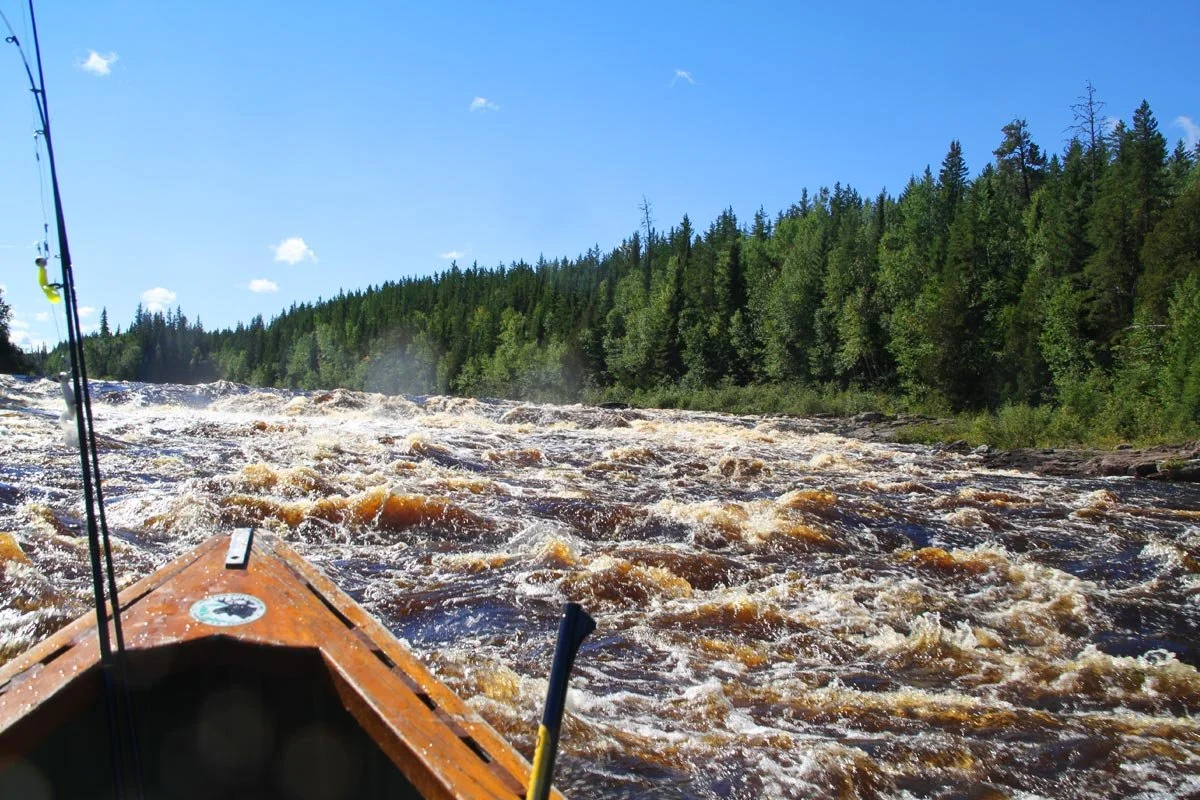
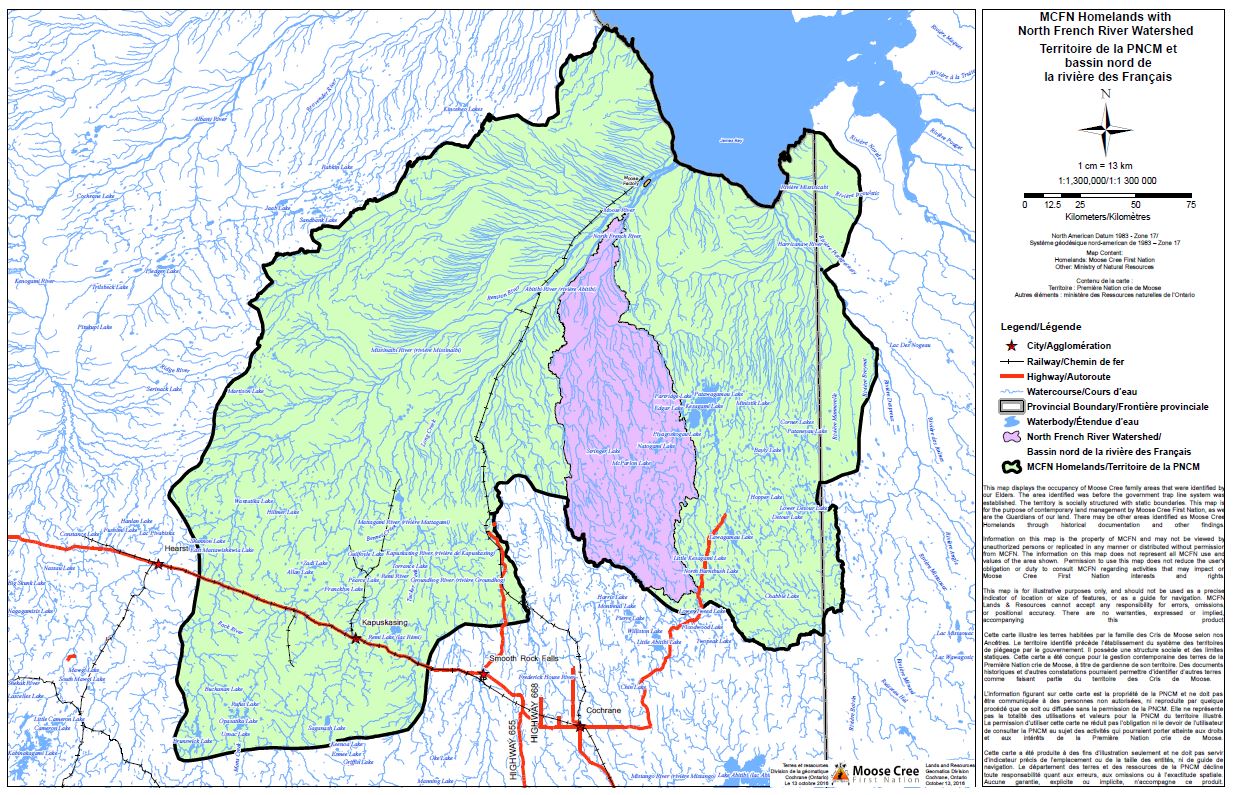
Spanning an intricate network of waterways and forests, the Kah-pana-yow Sibi / North French River lies at the heart of the Moose Cree First Nation’s homelands. [9] For decades, the Moose Cree have advocated for its protection, recognizing its cultural, ecological and spiritual significance. [10] In 2002, the Moose Cree Nation declared protection status for this pristine and intact watershed under its own laws.
The Nation’s vision is to halt industrial activities such as mining and forestry across 515,000 ha, and ensure the land remains accessible for traditional and cultural use. Today, Moose Cree First Nation is working with Ontario and Canada to establish an Indigenous Protected and Conserved Area for the French River. [11]
Funding sources:
Environment and Climate Change Canada (Canada Nature Fund)
Metcalf Foundation
International Boreal Conservation Campaign
Partner:
Wildlands League
Bringing back elements of the original natural ecosystem in an area degraded by human activity is sometimes called “restoration.”
Restoration is about assisting nature in recovering after damage. Among other activities, it sometimes involves improving native species diversity in an area, which has been shown to increase an area’s carbon storage potential. [12]
One type of forest restoration is “proforestation,” in which previously logged forests are allowed to recover naturally to achieve their full carbon and biodiversity potential. [13]
Example: Bonanza Wetlands Enhancement Project
The Bonanza Ecosystem Enhancement Project was a 3-year project that began in 2019, with the goal of restoring and enhancing three wetlands near Hills, BC: Hunter Siding, Upper Bonanza, and Summit Marsh Lake [14]. The project was part of the larger Bonanza Biodiversity Corridor Project, which created a protected corridor between Slocan and Summit Lakes, and Valhalla and Goat Range Provincial Parks. The corridor is approximately 140 km2 and a biodiversity hotspot.
The goal of the Bonanza Wetlands Enhancement Project was to restore landscape-level hydrologic functioning and ecological processes that have deteriorated over time due to railroad tracks, forestry roads, and cut blocks. This work contributes to a healthier wetland-riparian system, promotes habitat continuity, and provides long-term ecological benefits by improving water flow and sensitive aquatic and terrestrial wildlife habitats [15].
Hunter Siding restoration activities have focused on recreating cedar-cabbage skunk swamps and lady fern swamps. Upper Bonanza restoration activities focused on removing a section of rail bed that passed through the wetland complex to reconnect valley bottom areas that had been previously cut off from the creek. Work also made the creek’s mainstream flow more natural and added large logs to improve habitat for the Rainbow Trout.
Restoration activities in the Summit Lake Marsh included managing how the water flows between upstream and downstream areas, keeping recreational trail users out of the wetlands, and reducing flooding and erosion of the old rail trail into the wetlands.
The project continues to monitor the wetlands to assess the effectiveness of interventions and to ensure their continuation post-project. Reports from years 1-3, as well as monitoring reports beyond the project end date, can be found on the Kootenay Conservation Program website. [16]
Partners:
Slocan Lake Stewardship Society
Okanagan Nation Alliance
Known funders:
Environment and Climate Change Canada (Kootenay Connect’s Community Nominated Priority Places)
Columbia Basin Trust (Ecosystems Enhancement Program)
North French River. Photo credit: Moose Cree First Nation
North French River. Photo credit: Moose Cree First Nation
2. Restoration
One of the most effective ways to reduce GHGs is to protect natural ecosystems from activities that degrade them. Carbon-dense natural ecosystems in Canada include primary forests (never been logged), native prairie grasslands, wetlands, salt marshes, and eelgrass beds. Preventing the logging of primary forests, the plowing of native grasslands and the draining of wetlands helps these ecosystems continue to store carbon and maintain their natural resilience to the effects of climate change.
It is wise to prioritize protecting natural areas over restoring degraded areas, as we do not know that every ecosystem component that existed prior to degradation can be brought back through human intervention.
In forest tenure, farms, or suburban landscapes with remnant natural ecosystems, retaining these areas improves emissions and biodiversity outcomes.
In a landscape managed for timber extraction, for example, improved management could be achieved by reducing the volume of trees harvested, extending rotation age, or increasing the area of patches retained for wildlife.
3. Improving management in working landscapes
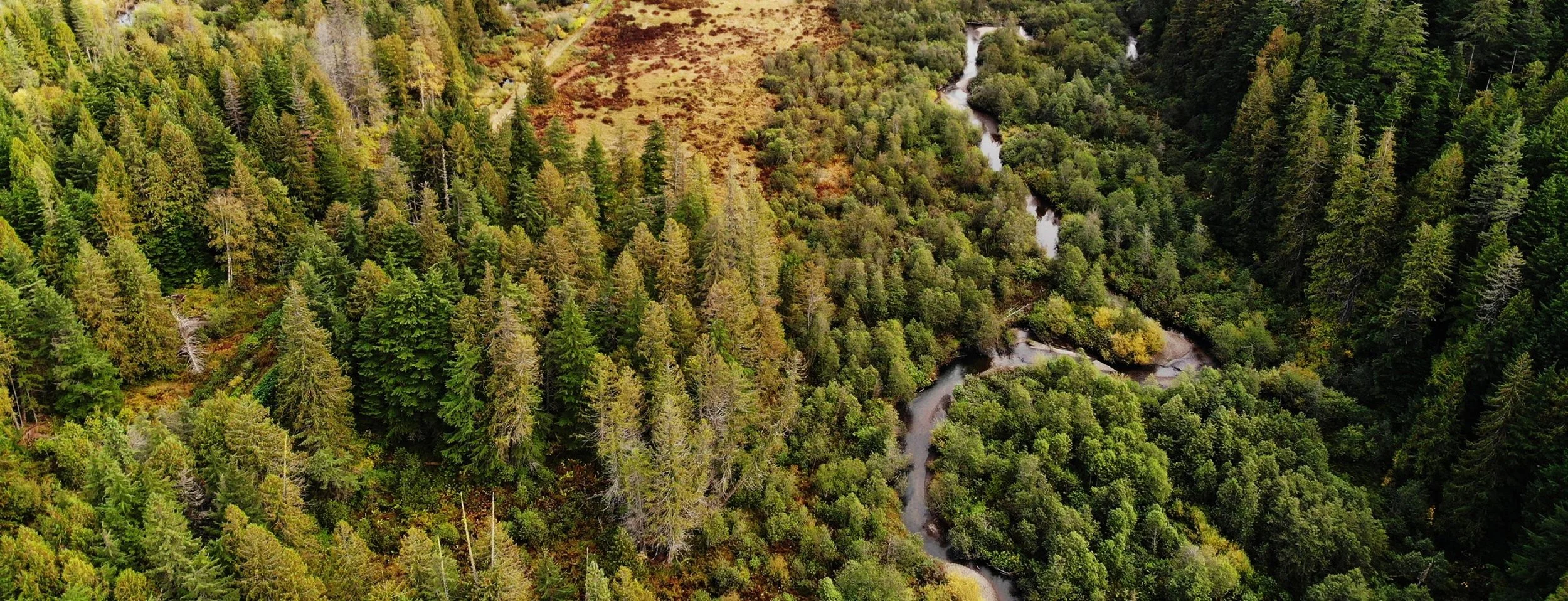
Bonanza Biodiversity Corridor. Photo credit: Kootenay Conservation Program
-
[9] Wildlands League, (n.d.), https://wildlandsleague.org/media/NorthFrench.jpg
[10] Moose Cree First Nation, (2021). MCFN Reaffirms its Commitment to Protecting the North French River Watershed., https://www.moosecree.com/our-commitment-to-the-north-french-river-watershed/
[11] Matteo Cimellaro, “Moose Cree First Nation hopes to finally work with Ontario government to save watershed,” Canada’s National Observer, October 25, 2021, https://www.nationalobserver.com/2021/10/25/news/moose-cree-first-nation-hopes-finally-work-ontario-government-save-watershed.
[12] Strassburg, B.B., Iribarrem, A., Beyer, H.L., Cordeiro, C.L., Crouzeilles, R., Jakovac, C.C., Braga Junqueira, A., Lacerda, E., Latawiec, A.E., Balmford, A. and Brooks, T.M., (2020). Global priority areas for ecosystem restoration. Nature, 586(7831), 724-729.
[13] Moomaw, W.R., Masino, S.A. and Faison, E.K., (2019). Intact forests in the United States: Proforestation mitigates climate change and serves the greatest good. Frontiers in Forests and Global Change, 2:27. doi: 10.3389/ffgc.2019.00027
[14] Slocan Lake Stewardship Society. (2024). Kootenay Connect: Bonanza Biodiversity Corridor Restoration Site Effectiveness Monitoring. Available from: kootenayconservation.ca/wp-content/uploads/2024/07/SLSS_KC_Bonanza_Yr5_Monitoring_and_Maintenance_Report_Mar2024.pdf
[15] [16] Peyton, C., Durand, R., Thomson, A. (2022). Bonanza Wetlands Enhancement Project (BoWEP) Monitoring and Adaptive Management. Available from: https://kootenayconservation.ca/wp-content/uploads/2022/06/SLSS_KC_Bonanza_Restoration_Monitoring_Report_Mar2022-1.pdf
Cheakamus Community Forest. Photo credit: Joseph Pallant
Example: Improved Forest Management in the Cheakamus Community Forest
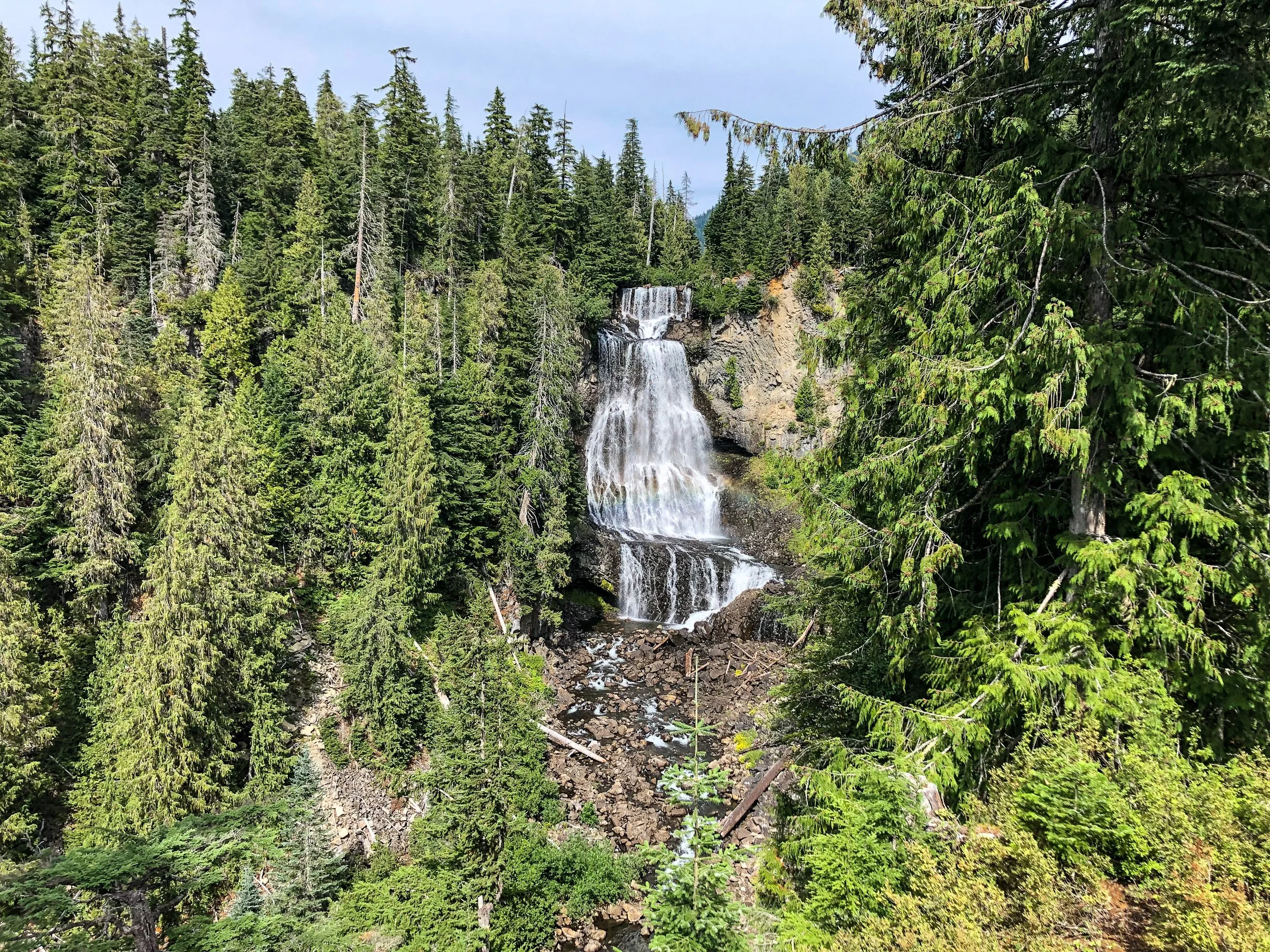
The Resort Municipality of Whistler, Sḵwx̱wú7mesh Úxwumixw (Squamish Nation), and Lil̓wat7úl (Lil'wat Nation) jointly manage 33,000 ha of forest under the auspices of Cheakamus Community Forest Society, an independent non-profit since 2009. Through an updated land analysis based on community values, the Cheakamus Community Forest (CCF) and its partners reduced the amount of timber harvested from 40,000 m³ to 21,000 m³ by reducing harvest volumes, extending harvest rotations, expanding reserves, and protecting old-growth forests and other important wildlife habitats. About 15,000 ha are protected from commercial harvesting through a variety of legal and voluntary mechanisms.
The CCF is the first carbon project established in a BC forest tenure and the first project in any community forest tenure in Canada.
Funding source:
Carbon credit revenue from the BC offset system
Partner:
Resort Municipality of Whistler
Sḵwx̱wú7mesh Úxwumixw
Lil̓wat7úl
Brinkman Climate
Natural climate solutions in a changing climate
One of the most common arguments against protecting natural ecosystems as a climate solution is that climate change is destroying nature, and therefore, humans must manage natural ecosystems to continue benefiting from the services they provide [17]. However, this argument is not supported by the current Western scientific understanding of nature and resilience [18].
In fact, the less industrial interference a natural ecosystem, such as a primary forest, has experienced, the more resilient it is to the effects of a changing climate [19]. Natural ecosystems have higher adaptive capacity and stability than forests under industrial pressure due to their connectivity, biodiversity, and microclimate buffering [20].
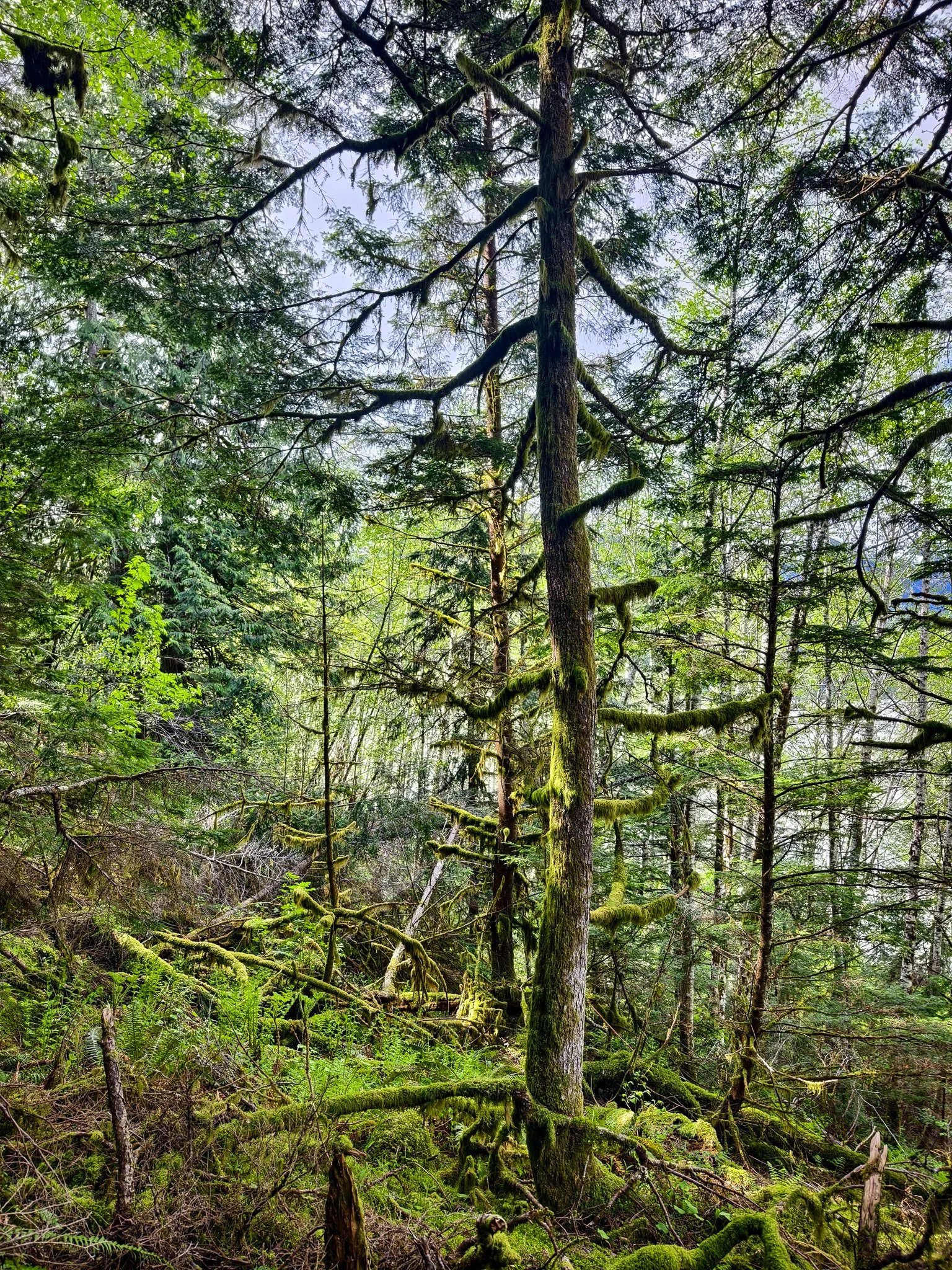
To illustrate microclimate buffering, think about what it feels like to walk outside on a hot day.
Then imagine walking into an old forest, where it’s much cooler.
Primary forests modify the impacts of climate by conserving water, providing shade and protecting plants and animals from drought stress and extreme temperatures, both hot and cold. They absorb heat during the day and release it slowly at night, thereby evening out the extremes.
In forests, natural disturbances such as fire and insect outbreaks are essential processes that drive renewal, nutrient cycling, and habitat creation. [21] These events are becoming more extensive and severe with climate change. Primary forests are generally more resistant to fire because of higher humidity and moisture, the presence of ferns and mosses that help retain water by limiting light penetration to the forest floor and much less human access. [22] Industrial activity that creates roads and removes trees in primary forests can increase emissions, impair sequestration, and reduce carbon stores. [23]
In contrast, recently logged areas contain “slash” (waste material following logging) and drier conditions, which can increase flammability and fire spread. [24] Fires in previously logged or managed landscapes can be more severe and take longer to recover than fires in primary forests or older secondary forests. Fine woody debris, lower moisture levels, and dense tree stands all contribute to more intense fire behaviour, including crown fires (fast-moving fires that spread through the tops of trees), and slower recovery [25].
Primary forests recover more rapidly from beetle outbreaks if they are left alone than if they are logged. [26] This is due to the remaining living trees of different sizes, legacy understory plants, and soil microbial communities.[27]. In contrast, removing beetle-killed trees alters the forest’s normal recovery and the distribution of dead-wood legacies — the standing snags and fallen logs that are crucial for biodiversity and the soil conditions forests need to recover. [28] Removing surviving trees following a beetle outbreak in a primary forest reduces the adaptive capacity of that forest because surviving trees have greater genetic resistance to beetles and may have a tolerance to new climatic conditions [29].
Generally, tree removal by people, as an attempt to increase resilience in primary forests, either before or following fire or insect outbreaks, bypasses natural selection in response to climate change because humans select which trees die or persist rather than natural stressors [30].
How do we support the resilience of natural ecosystems so that they can continue to store carbon, provide important habitat and safeguard their adaptive capacity?
We leave them alone.
-
[17] [18] Lindenmayer, D., Zylstra, P., Hanson, C.T., Six, D. and DellaSala, D.A., (2025). When Active Management of high conservation value forests may erode biodiversity and damage ecosystems. Biological Conservation, 305, p.111071.
[19] Rogers, B.M., Mackey, B., Shestakova, T.A., Keith, H., Young, V., Kormos, C.F., DellaSala, D.A., Dean, J., Birdsey, R., Bush, G. and Houghton, R.A., (2022). Using ecosystem integrity to maximize climate mitigation and minimize risk in international forest policy. Frontiers in Forests and Global Change, 5, 929281.
[20] Mackey, B., DellaSala, D.A., Kormos, C., Lindenmayer, D., Kumpel, N., Zimmerman, B., Hugh, S., Young, V., Foley, S., Arsenis, K. and Watson, J.E., (2015). Policy options for the world's primary forests in multilateral environmental agreements. Conservation Letters, 8(2), 139-147. Frontiers in Forests and Global Change, 5, p.929281.
[21] Seidl, R., Thom, D., Kautz, M., Martin-Benito, D., Peltoniemi, M., Vacchiano, G., Wild, J., Ascoli, D., Petr, M., Honkaniemi, J. and Lexer, M.J., (2017). Forest disturbances under climate change. Nature climate change, 7(6), 395-402.
Thom, D. and Seidl, R., (2016). Natural disturbance impacts on ecosystem services and biodiversity in temperate and boreal forests. Biological Reviews, 91(3), 760-781.
[22] Lindenmayer, D.B., Hunter, M.L., Burton, P.J. and Gibbons, P., (2009). Effects of logging on fire regimes in moist forests. Conservation Letters, 2(6), 271-277.
Ough, K., (2001). Regeneration of Wet Forest flora a decade after clear-felling or wildfire-is there a difference?. Australian Journal of Botany, 49(5), 645-664.
Taylor, C., McCarthy, M.A. and Lindenmayer, D.B., (2014). Nonlinear effects of stand age on fire severity. Conservation Letters, 7(4), 355-370.
[24] Lindenmayer, D., Zylstra, P., Hanson, C.T., Six, D. and DellaSala, D.A., (2025). When Active Management of high conservation value forests may erode biodiversity and damage ecosystems. Biological Conservation, 305, 111071.
[25] xxv Dieleman, C.M., Rogers, B.M., Potter, S., Veraverbeke, S., Johnstone, J.F., Laflamme, J., Solvik, K., Walker, X.J., Mack, M.C. and Turetsky, M.R., (2020). Wildfire combustion and carbon stocks in the southern Canadian boreal forest: Implications for a warming world. Global change biology, 26(11), 6062-6079.
Kukavskaya, E. A., Buryak, L. V., Ivanova, G. A., Conard, S. G., Kalenskaya, O. P., Zhila, S. V., et al. (2013). Influence of logging on the effects of wildfire in Siberia. Environ. Res. Lett. 8:045034.
Lindenmayer, D.B., Hunter, M.L., Burton, P.J. and Gibbons, P., (2009). Effects of logging on fire regimes in moist forests. Conservation Letters, 2(6), 271-277.
Lindenmayer, D.B., Hobbs, R.J., Likens, G.E., Krebs, C.J. and Banks, S.C., 2011. Newly discovered landscape traps produce regime shifts in wet forests. Proceedings of the National Academy of Sciences, 108(38), pp.15887-15891.
Odion, D.C., Frost, E.J., Strittholt, J.R., Jiang, H., Dellasala, D.A. and Moritz, M.A., (2004). Patterns of fire severity and forest conditions in the western Klamath Mountains, California. Conservation Biology, 18(4), 927-936.
Thompson, J. R., Spies, T. A., and Ganio, L. M. (2007). Reburn severity in managed and unmanaged vegetation in a large wildfire. Proc. Natl. Acad. Sci. U.S.A. 104, 10743–10748.
[26] Donato, D.C., Harvey, B.J., Romme, W.H., Simard, M. and Turner, M.G., (2013). Bark beetle effects on fuel profiles across a range of stand structures in Douglas‐fir forests of Greater Yellowstone. Ecological Applications, 23(1), 3-20.
Griffin, J.M., Simard, M. and Turner, M.G., 2013. Salvage harvest effects on advance tree regeneration, soil nitrogen, and fuels following mountain pine beetle outbreak in lodgepole pine. Forest Ecology and Management, 291, pp.228-239.
Rhoades, C.C., Hubbard, R.M., Elder, K., Fornwalt, P.J., Schnackenberg, E., Hood, P.R. and Tinker, D.B., 2020. Tree regeneration and soil responses to management alternatives in beetle-infested lodgepole pine forests. Forest Ecology and Management, 468, p.118182.
Steinke, J., McIntosh, A.C., Schroeder, L. and Macdonald, S.E., 2020. Understory vegetation responses to simulated mountain pine beetle attack and salvage logging in grey attack stage lodgepole pine stands. Forest Ecology and Management, 474, p.118373.
[27] Amoroso, M.M., Coates, K.D. and Astrup, R., (2013). Stand recovery and self-organization following large-scale mountain pine beetle induced canopy mortality in northern forests. Forest Ecology and Management, 310, pp.300-311.
Kayes, L.J. and Tinker, D.B., (2012). Forest structure and regeneration following a mountain pine beetle epidemic in southeastern Wyoming. Forest Ecology and Management, 263, 57-66.
[28] Thorn, S., Bässler, C., Svoboda, M. and Müller, J., (2017). Effects of natural disturbances and salvage logging on biodiversity–Lessons from the Bohemian Forest. Forest Ecology and Management, 388, pp.113-119.
[29] Six, D.L., Trowbridge, A., Howe, M., Perkins, D., Berglund, E., Brown, P., Hicke, J.A. and Balasubramanian, G., (2021). Growth, chemistry, and genetic profiles of whitebark pine forests affected by climate-driven mountain pine beetle outbreaks. Frontiers in Forests and Global Change, 4, p.671510.
[30] Kuparinen, A., Savolainen, O. and Schurr, F.M., (2010). Increased mortality can promote evolutionary adaptation of forest trees to climate change. Forest Ecology and Management, 259(5), pp.1003-1008.